Monday, October 1, 2007

Support Real Stereo

(This is an archived post from our old blog.)

The folks over at TNT-Audio have started the Campaign for Real Stereo.

I'll support that. I only have two ears.

(That doesn't mean I won't be perfectly happy to sell you five speakers!)

Wednesday, September 5, 2007

NASA's Gold Record

(This is an archived post from our old blog.)


Being a fan of LP records as well as spaceships, I've long been fascinated with the fact that the Voyager spacecraft have LP records on board, complete with instructions on how to play them.

But here's a recent article from the New York Times by Timothy Ferris who produced the LP.

He talks about how the record should last a billion years and how it almost didn't make it on board the spacecraft.

Really fascinating stuff.

(click image to enlarge)


There's Uranium 238 on the surface of the record so that someone, somewhere might be able to figure the age of the record.

Here's the Jet Propulsion Laboratory's official page on the Voyager record.

Jet Propulsion Lab's site also has some of the images that the disk contains.

It's a little eerie to look at the photos since we're sure to be cosmic dust by the time anyone finds the Voyager.

Cool.

Monday, August 6, 2007

Brutal Honesty in the Hi-Fi Business: Tim de Paravicini and tube warmth

(This is an archived post from our old blog.)

Hi-Fi. It's short for "High Fidelity". If fidelity means "the degree of exactness with which something is reproduced" (as the Oxford American Dictionary says) then wouldn't the best hi-fi system be one that plays back the recording as faithfully as possible?

Well, that's what we think. Once the music is recorded, we want the experience of listening to the recording to be as much like "being there" as possible. We don't want our hi-fi system to add "warmth" or "color" or anything else. We don't think The Philadelphia Story would be better in color and we don't think The Godfather would be better if we watched it through a sheet of gauze, so why would we want our hi-fi to "warm up" the recording?

...and since we feel this way, we thought we'd share a great quote that we came across in an interview of Tim de Paravicini of E.A.R. We don't know Tim de Paravicini and we don't sell his equipment. We just think it's a great quote.

interviewer: You use vacuum tubes in many of your designs. Some people have said that tubes have euphonic even-order harmonic distortion. Do you rely on this tube nonlinearity to achieve the sound of your mods, or do you always run the tubes in their linear region?

Tim de Paravicini: I do not rely on tube nonlinearity. I don't want a sound in my machines. What comes out must sound the same as what went in.

The "warmth" in a lot of tube electronics is due to their dismal top end, the bad transformers they use, and the loading down of their high-impedance outputs. Because of the output transformer and the feedback used, many tube circuits have a partial bass instability that gives a bloated bass. Any warmth in the tube sound is a defect, but listeners don't want to know that.

I don't have to use tubes in my designs; I only do it for marketing reasons. I've got an exact equivalent in solid state. I can make either type do the same job, and I have no preference. People can't pick which is which. And electrons have no memory of where they've been! The end result is what counts.


Our hats are off to Mr. de Paravicini. More people like this in the hi-fi business, please!

Here's the link to the entire interview over at E.A.R.

Wednesday, August 1, 2007

Avantone Mixcubes

(This is an archived post from our old blog.)


Let's say you've been reading up on single-driver speakers and are considering further investigation. Where do you start? If you go looking through the internet you'll likely discover a world of D.I.Y. speaker enclosures as tall as NBA players with drivers that are barely larger than a compact disc. Relax. All you wanna do is get your feet wet, right?

There's a little speaker called the Avantone Mixcube. I mentioned them in a previous post about the Auratone 5C. The Mixcubes are around $200 per pair. They're 93dB efficient so you can run them on just about anything.

The main thing is that we think they sound great. They really have that "single-driver musicality". This isn't a case of "spec a driver, slap it in a box and put your name on it". Ken Avant really worked with every aspect of this thing. And the presentation is great, too. A huge improvement over the Auratone 5C, with it's pasteboard/contact paper construction.

We know several people who have Best Buy-grade surround receivers who use Avantones with excellent results. They're great for movies and bring a terrific clarity to the dialogue.

I sometimes feel like we're shooting ourselves in the foot by recommending the Mixcubes. After all, we sell speakers that cost forty times as much. But really, they're like a "gateway drug". And in side-by-side comparisons, yes, the Tocaro 40s are worth the difference (shameless plugs abound!)

I'll warn you that there's a break-in time associated with the Mixcubes just so you don't get them out of the box and wonder what I'm talking about. During the first week or two of listening, they get a good deal better every day. This is not uncommon, in fact, I guess I don't really know of any loudspeaker that comes from the factory already broken in.

Did I mention that they have 1/4" Neoprene pads on the bottom? Or that they're shielded?

I can't recommend this little speaker enough. They're a bang-for-your-buck champ.

Here's the spec sheet from Avantone.


Wednesday, July 11, 2007

TV alert: Old, Weird America/Harry Smith

(This is an archived post from our old blog.)


We really don't watch much television, and most of what we do watch is on Ovation (the Arts Network, as they say.) A documentary about Harry Smith's Anthology of Folk Music will be on Ovation on July 15 and 16.

Here's the info from Ovation.

Harry Smith's Anthology of Folk Music is an amazing collection that we highly recommend.

Here's where you can get The Anthology of Folk Music.

photo of Harry Smith by Brian Graham


Your computer as a high-end playback device?

(This is an archived post from our old blog.)


I know a lot of folks have their music stored on a computer. I mean, hey, it's a whole new century and all that, right?

Here's what we sometimes encounter; someone has a nice hi-fi system in their house, maybe it's got a turntable and maybe it's got a CD player, maybe it's got both. But some time in the past couple of years or so their computer has become their primary playback device. And most of the time they'll have some small powered speakers connected to the computer. In most cases, they don't have the computer connected to the hi-fi; in some cases they do.

Does this sound like you? And would you like to know how to get the best sound out of your computer?

I think a lot of people are using iTunes. If you're not, chances are most of this applies to you anyway. Some of the terms might be different, though.

To begin with, there are some issues with the software that you might not be aware of.

iTunes seems to default to Advanced Audio Coding, or AAC. This is a way to "reorganize" the data in a "lossless" way in order to save space. Apple has made a pretty big deal about the new iTunes Plus which features AAC at 256 kbps instead of the usual 128 kbps. I say don't get excited. I downloaded both the Beastie Boys' "Paul's Boutique" and David Bowie's "Ziggy Stardust and the Spiders from Mars" from the new iTunes Plus store and compared them to the commercially manufactured Compact Discs. The "real" manufactured Compact Discs sounded miles better.

So what's the better option? Buy the commercially manufactured Compact Disc and import it into iTunes. I know, that means you either have to go to the store or order online, but if you've read this far, I'll assume you actually want your setup to sound better. Besides, don't you want to support your local music retailer?

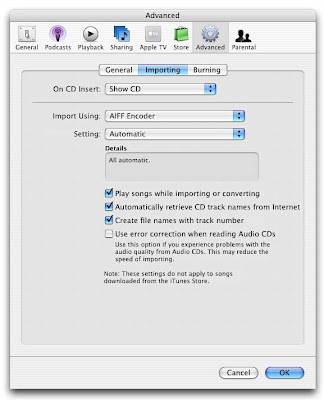
So get the CD. But now you have to change a preference in iTunes. Otherwise it'll be importing with the default AAC encoder which we're trying to avoid by not buying from the iTunes online store.

Open the Preferences pane and go to "Advanced" and then click on the button at the top that says "Importing". Now change the "Import Using..." pull-down menu to "AIFF Encoder" or "WAV encoder".

Here's a screenshot in case that was confusing:


Now, while you're in there, make sure that both the equalizer and the Sound Enhancer are turned off. The Sound Enhancer defaults to "on".

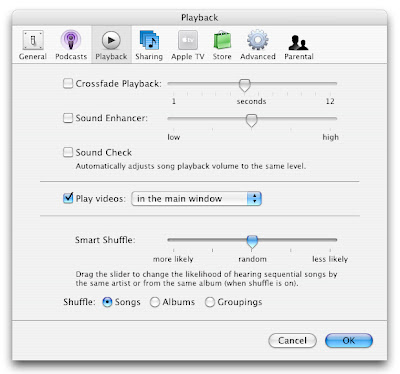
To disable the Sound Enhancer, go to the iTunes pull-down menu and open the Preferences pane. Now, at the top of that pane, click on "Playback". If Sound Enhancer is on, turn it off. I also say turn off the Sound Check option. Sound Check makes iTunes files play back at a more matched volume, but there's a problem with doing that; iTunes is capable of bit-perfect playback, but only if you don't reduce the output before your Digital to Analog Converter.

This means you also want to have the volume on the iTunes interface turned all the way up, as well as the main volume output control on your computer.

Here's a screenshot of the Sound Check preference:


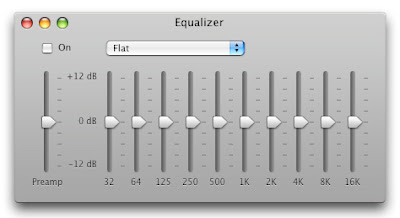
Now you should check to see if the iTunes equalizer is enabled.

To access the equalizer, go to the top of the screen to the "View" menu and select "Show Equalizer". When the equalizer pops up, make sure the "ON" box is unchecked, like in the screenshot below:


One thing I should mention is that your library is gonna get big. Quick. AIFF and WAV files take up more room than AAC files. But this is good. They sound better and hard drive space is cheap so you can afford to pony up. But again, if you've read this far...

So now you're getting better files into iTunes. But you're still using the Digital to Analog Converter (or DAC) that came with your computer, right? That's the thing that some people call the "soundcard". It's the thing that the mini-jack is attached to on the inside. If it's the one that came with your computer, it's not a very good one. In fact, it's several rungs below the Digital to Analog Converter in any cheap DVD/CD player.

Mastering Guru Bob Katz says this:

Most computer-based digital audio cards have quite high jitter, which makes listening through them a variable experience. It is very difficult to design a computer-based card with a clean clock--due to ground and power contamination and the proximity of other clocks on the computer's motherboard.

What I suggest is a good, outboard DAC (Digital to Analog Converter) that's USB compatible. We recommend the Benchmark DAC1 usb. We don't sell them and we recommend making sure your computer will send digital audio out through the USB, but most modern computers will.
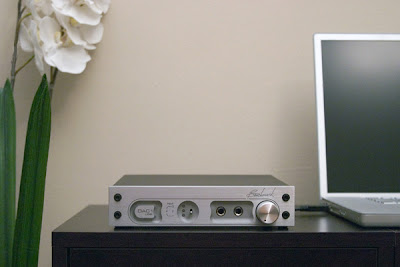


The DAC1 usb connects to your computer via USB and connects to your hi-fi just like a CD player would. Once it's connected to your computer, it'll show up in your sound control panel as an audio output option. It's got a volume control and even has two headphone outputs.

Look, we know that iTunes has made it easier for lots of people to access their music. And we think that's a great thing no matter what. And even if you still want to download music from iTunes, the outboard DAC will make the music better.

Hopefully all this isn't too confusing. If it is, let us know.

See you soon!


Tuesday, July 3, 2007

1921 Victor Talking Machine

(This is an archived post from our old blog.)


Ethel Waters' "Moonglow" on a 1921 Victrola VV80.

I find it amazing how good these players sounded.